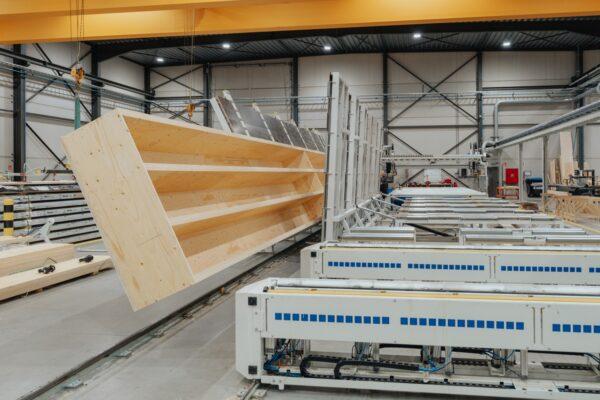
Demand for sustainable building methods is rising, and timber construction is playing an increasingly important role. DUPAC focuses on producing bonded Kerto-Ripa elements that make it possible to achieve large spans without intermediate supports. This positions the company as a specialist in large-scale timber structures.
Spans of up to 20 metres
What sets the Kerto-Ripa elements apart is the combination of high strength and relatively low weight. Structural bonding creates rib panels capable of free spans of up to twenty metres. That opens the door to large spaces such as sports halls, schools, offices and commercial buildings, where an open floor plan and flexible layout are often desirable.
Automation and quality assurance
To guarantee consistent quality, DUPAC relies heavily on automated production processes. Bonding is a crucial step: only under controlled conditions does a connection achieve the required structural performance. Strict checks throughout the process are intended to ensure that every element meets the set requirements.
This approach fits a broader trend in the sector, in which prefabrication and industrialisation are becoming ever more important. Elements produced in advance at the factory reduce the risk of errors on site, shorten construction times and limit disruption in the immediate surroundings.
Customisation and scaling up
Alongside standard solutions, DUPAC offers scope for custom work, allowing elements to be tailored to specific project requirements. At the same time, the company is working to scale up production further in order to meet the growing interest in timber construction.
- Large spans: free spans of up to 20 metres without intermediate supports.
- Structural bonding: essential for strength and reliability.
- Automated production: consistent quality and efficiency.
- Customisation: adaptation to the demands of each project.
For the construction sector, this development means more opportunities to build large structures in timber. As a result, timber construction is becoming a serious alternative to traditional building methods, both in terms of sustainability and construction speed.