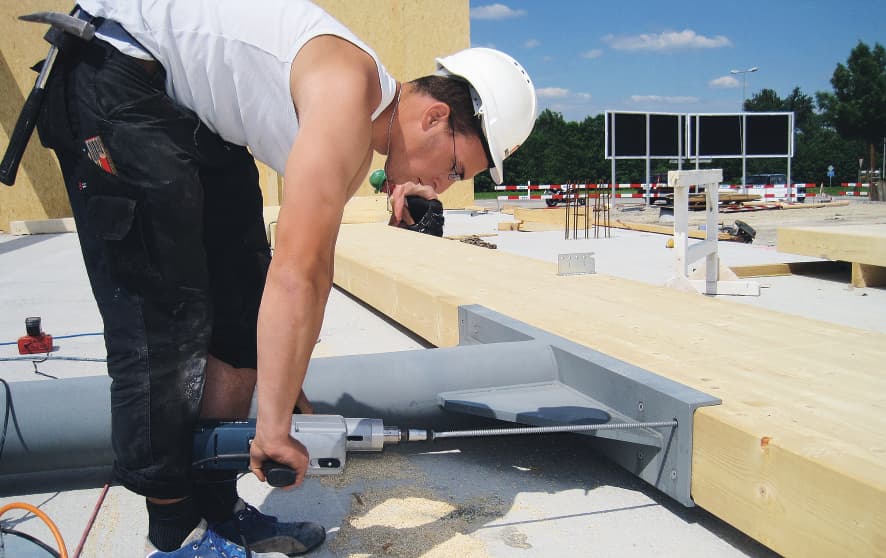
Timber construction is advancing quickly. Multi-storey buildings with large spans, built entirely or largely from wood, are becoming more common. This ambition places greater demands on the structural performance of timber components, especially as designers also aim for material-efficient and prefabricated solutions.
Rising demands on load capacity
More complex designs mean that timber profiles and composite components must carry heavier loads. Where simple connections once sufficed, today's generation of projects calls for carefully calculated reinforcement. The main challenge lies in managing tensile and shear forces within the material itself.
The role of full-thread screws
Full-thread screws and threaded rods prove highly effective for structurally reinforcing timber constructions. Because the thread engages the wood along its entire length, forces are distributed and absorbed evenly. Their function is comparable to that of reinforcing steel in reinforced concrete: the metal takes up the forces where the wood alone falls short.
- Reinforcement of connections across large spans
- Absorption of transverse and tensile forces in the wood
- Suitable for prefabricated and modular components
- Contribution to slimmer, material-efficient structures
This matters to the construction sector because prefabrication is becoming increasingly central. Components made in the factory and assembled on site require reliable and repeatable connections. Full-thread screws fit this process well, as they can be installed quickly while offering high load-bearing capacity.
The combination of sustainable material choices and robust fastening technology makes it possible to raise timber construction to a higher level. In doing so, wood becomes a full alternative to traditional building materials, even for demanding projects.