The construction sector faces a significant sustainability challenge, and concrete plays a dual role in it. It remains an indispensable building material, yet the way it is produced is changing rapidly. Clients increasingly set firm requirements around lower CO₂ emissions, more efficient use of raw materials, and greater circularity.
Going greener without giving in
The core of the challenge is clear: concrete must become more sustainable, but not at the expense of quality, load-bearing capacity, or usability. For producers, this means re-examining mixes, raw materials, and production processes. The aim is concrete with a smaller environmental footprint that still performs just as reliably as conventional alternatives in everyday practice.
Key levers to pull include:
- Lower CO₂ through adjusted compositions and alternative binders;
- More efficient material use, requiring less raw material for the same structural properties;
- Greater circularity via reuse and the reusability of materials.
Practical applications
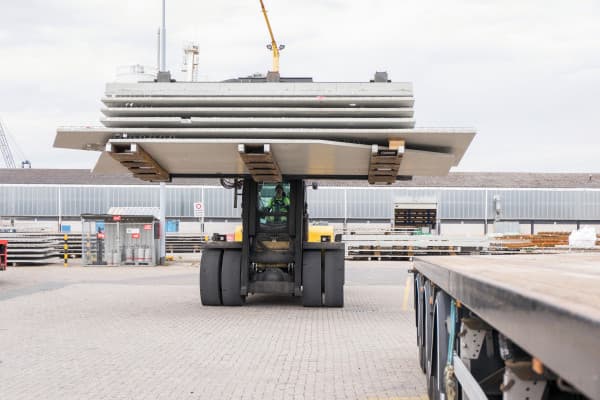
At Dycore, this effort has resulted in the development of the Eco-Breedplaatvloer® and the Eco-Ribbenvloer®. Both products demonstrate that sustainability and structural performance can go hand in hand. They are designed to fit into existing building processes, allowing architects, structural engineers, and contractors to choose a more sustainable alternative without having to overhaul their methods.
For the construction industry, this is an important step. Floor systems account for a large share of material use in residential and commercial building, which is precisely where meaningful gains can be made. By reducing the environmental impact of commonly used elements, the overall footprint of a project shrinks while structural certainty remains intact.
The development is part of a broader movement in which concrete producers take responsibility for their emissions. Sustainability is therefore no longer an abstract ambition, but a concrete product choice that can be applied directly on the building site.